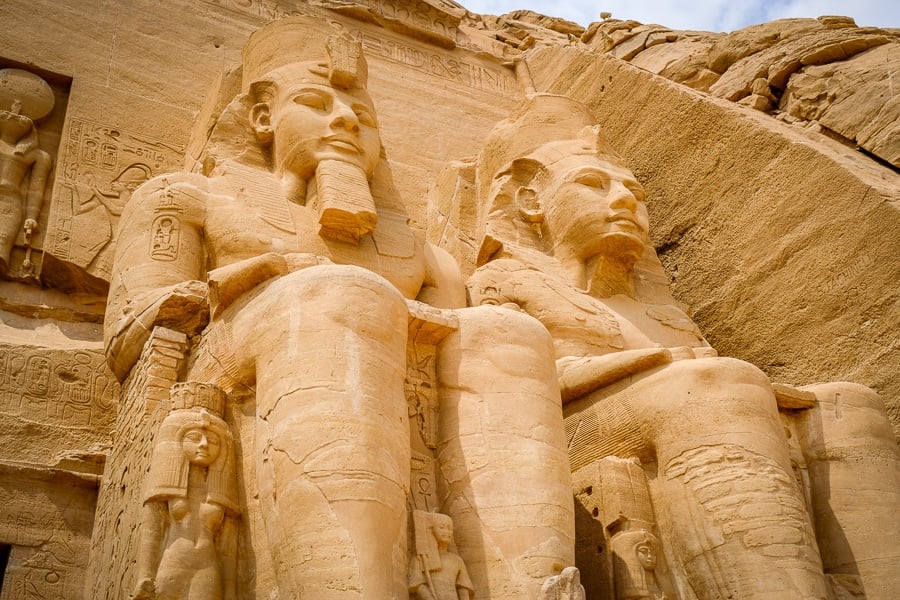
The Abu Simbel Temple in Egypt may not be as well known as the pyramids, but it was easily one of my favorite travel experiences ever. This is an incredible ancient temple, thousands of years old, located in a remote corner of Egypt near the border of Sudan.
Walking around these colossal pharaoh statues carved into the side of the rock feels a bit like you’re wandering back in time, or maybe you’ve just stepped into an Indiana Jones movie. This travel guide will explain how to get there, and everything you need to know before you go!
This UNESCO World Heritage Site stands as a powerful symbol of ancient Egyptian engineering, religion, and political ambition. Located in southern Egypt near the Sudanese border, Abu Simbel attracts travelers, historians, and culture lovers from around the world.
What Is Abu Simbel?
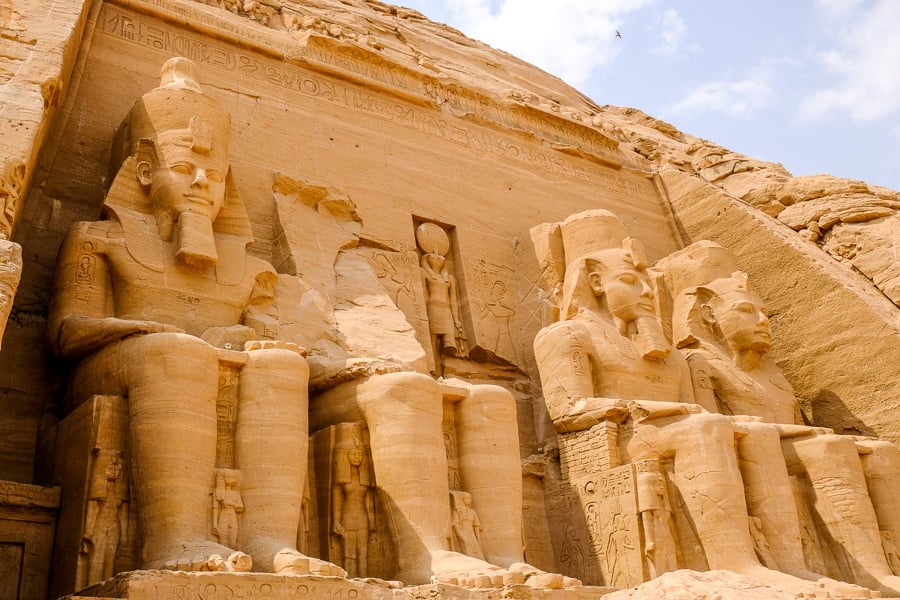
The Abu Simbel temples were built in 1244 BC and they’re dedicated to Pharaoh Ramses II and Queen Nefertari. There’s a big temple for Ramses, and a smaller one for Nefertari. The point of this monument was to celebrate King Rameses II’s victory over the Hittites at the Battle of Kadesh in 1274 BC, which was believed to be one of the largest chariot battles in history.
The temples were rediscovered by a Swiss explorer in 1813, but they had been buried by sand and no one was able to find an entrance until it was excavated in 1817 (how cool is that?). The entire temples had to be moved in 1968 as part of a huge project by UNESCO to save them from being flooded and destroyed by Lake Nasser. Today they sit on the west bank of the lake, but everything else looks exactly how it did 3,000 years ago.
In addition to the main temple, there is a smaller temple built for Queen Nefertari. In front of the temple are two statues of the queen and four statues of the pharaoh, each about 33 feet (10 m) tall. Each is engraved with hieroglyphs.
Modern Egypt
This site was built by an Egyptian ruler and is located in modern Egypt, considered part of Nubia, a region that was sometimes independent of ancient Egypt. It was a powerful message to unwelcome visitors to the Nile River that the pharaoh was powerful and owned everything.
Religion and cultural heritage
Abu Simbel represents the meeting point of ancient Egyptian religion and art. The temples of Ramesses II were divinely empowered and promoted unity throughout southern Egypt. The post-solar worship and divine nature of the kingship at this site amazed the ancient world.
Abu Simbel stands as a powerful monument to the creativity and preservation of its people’s cultural heritage
Abu Simbel, a modern engineering marvel
Abu Simbel was threatened by rising water levels caused by the construction of the Aswan High Dam in the 1960s. In an unprecedented international effort led by UNESCO, entire temples were demolished and relocated to higher ground.
Reassembled with incredible precision, this massive rescue operation is considered one of the greatest archaeological conservation achievements of modern times and helped establish UNESCO’s World Heritage Program.
Best time to visit Abu Simbel Temples
The best time to visit Abu Simbel is from October to April, when the temperatures are cooler and more comfortable. I think it’s best to avoid the crowds and enjoy the temples in the quiet morning light. Alignment dates are particularly popular, though, as they attract a large number of visitors.
Some places to visit in Abu Simbel
Abu Simbel is a remarkable example of ancient engineering and storytelling. Visitors are attracted by the following:
UNESCO World Heritage status
Remarkable solar alignment
Colossal statues and detailed carvings
One of history’s greatest relocation projects
It provides an unforgettable glimpse into the power and vision of ancient Egypt.