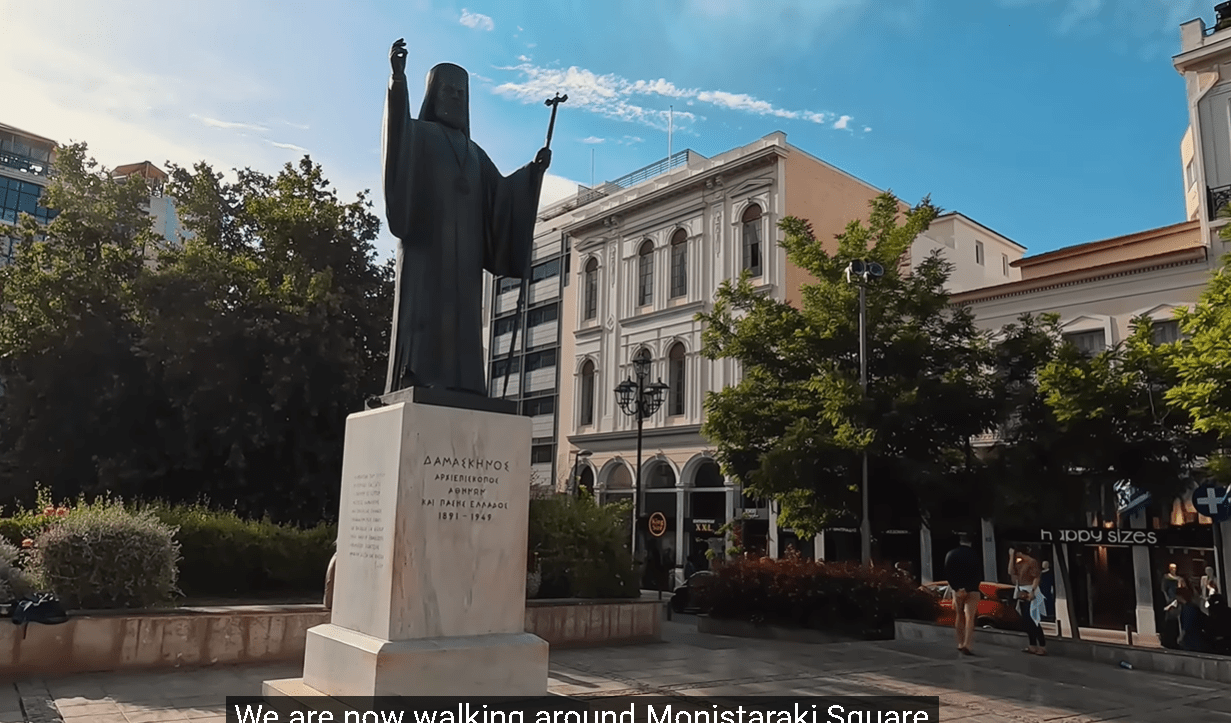
One of the most charming and historic neighborhoods in Athens, Greece. Plaka is located at the foot of the Acropolis and is often called the “Neighborhood of the Gods” due to its ancient ruins. With its cobblestone streets, neoclassical architecture, historic taverns, and vibrant cultural atmosphere, Plaka is now a popular tourist destination for travelers.
Plaka is its traditional character.
Plaka is the oldest residential area in Athens, with a history spanning thousands of years. Built on and around ancient ruins, the area reflects layers of Greek, Roman, Byzantine and Ottoman history, making it a major tourist attraction. Despite being the modern city center, Plaka has preserved its traditional character,
Plaka is surrounded by some of Athens’ most important historical sites. Nearby attractions include the Roman Agora, the Tower of the Winds, Hadrian’s Library, and the Ancient Agora of Athens. These sites offer visitors a direct dive into ancient Greek and Roman history and explore the surrounding area.
The area is also home to several small but interesting museums, such as the Museum of Greek Folk Art, the Museum of Musical Instruments, and the Jewish Museum of Greece. These cultural sites provide a deep insight into Greek heritage, music, and daily life throughout history.
Architecture and Streets
One of Plaka’s most striking features is its architecture. The area is filled with well-preserved neoclassical houses, colorful facades, wooden balconies, and stone paths. Many of the streets are pedestrian-only, allowing visitors to wander at their leisure. Iconic streets such as Adrianou Street, Kidathinaion Street, and Tripodon Street are lined with souvenir shops, cafes, and art galleries.
Plaka’s picturesque streets are ideal for photography, especially early in the morning or in the evening when the crowds are less. Bougainvillea-covered buildings and ancient stone walls create a pleasant atmosphere that reflects traditional Greek charm.
Agios Nikolaos Ragavas
Centuries of rain and wind have exposed the outer walls of Agios Nikolaos Ragavas and the pillars of the ancient temple on which the 9th-century church was built. On the corner of Pritanou Street and the Epiharmo steps, this small 11th-century domed church forms an interesting composition with the Acropolis standing behind it.
Originally, the church belonged to the Ragavas family, a great Byzantine family, as stated in an inscription found on a pillar during maintenance in the 1970s.
The small bell hanging inside the temple was rung in 1833 to call for the end of almost 400 years of Ottoman occupation. The use of bells was banned by decree and all were confiscated except for the bell of Agios Nikolaos Ragavas, which was kept in a secret cave.
The same bell was rung again for the first time on 12 October 1944, after the withdrawal of German troops.
The Pikionis Pathway
Although Kallitroetis and Iktinos meticulously designed the Parthenon, in the 1960s Dimitris was tasked with creating a network of paths around Philopappou Hill, Dionysios Areopagitos, and the Acropolis, which he successfully completed, revealing the archaeological value of the ruined buildings and fragments of ancient pottery and marble.
The paths were constructed using contemporary materials such as concrete and brick to create a timeline of the city’s history, mythology, past and present.
This innovative idea was expressed in an intervention that is rarely noticed by pedestrians and anyone not familiar with the intricate feats of the piscionis. As a result, few visitors to the area today realize that the paths are not ancient but were built decades ago.
Monument of Lysicrates
The monument is located in the middle of a square dug out next to Lysitruyets Plaka, which is perpendicular to Hadrian’s Arch and at the foot of the Acropolis hill. The shaded cafes there are a popular meeting place, providing inspiration and silence for thirsty travelers.
The monument is a rather strange sight than a pleasant one. In ancient times, the street was lined with many similar monuments erected by wealthy patrons of the theatre festival at the nearby Theatre of Dionysus, as a symbol of their patronage.
If the design sounds familiar, it probably is: it has been replicated in gardens in the UK, the US and elsewhere. The locals of Plaka refer to this spot as the “Lantern of Demosthenes”, because the orator would study late into the night and, of course, had to use a lantern for light.
Why Visit Plaka?
Plaka is a historic area in a small area, where culture, food and shopping all come together to create a perfect mix. Its location near the main attractions makes it easy to get around. Its traditional modern charm will make you want to stay away from the city. From ancient history, to local food, to leisurely walks, Plaka is a popular destination in Athens.